



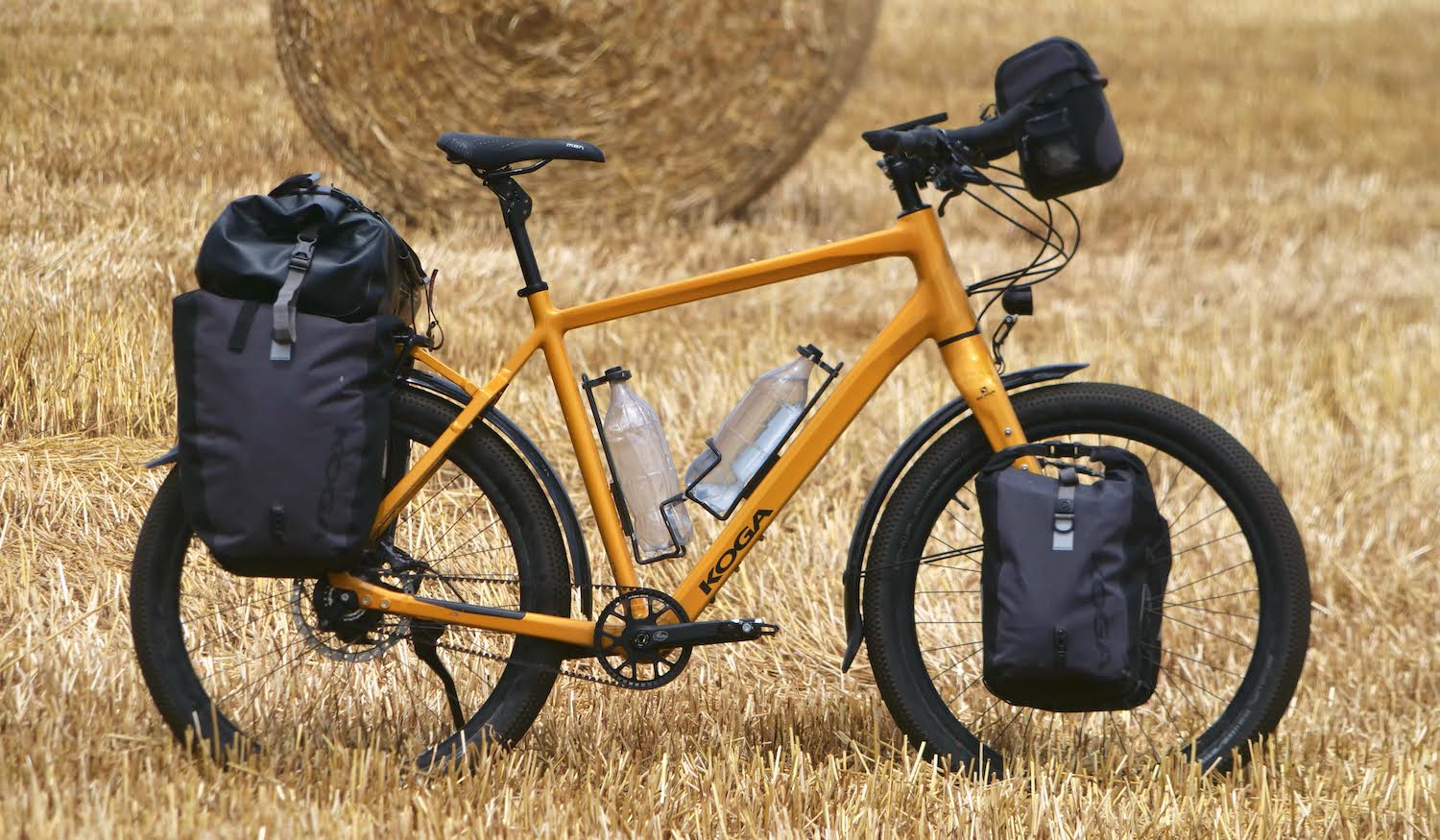
The 2026 KOGA WorldTraveller is an Indestructible Touring Bike
After more than 25,000 kilometres through scorching deserts, rugged mountains, and bone-rattling backroads, this KOGA WorldTraveller hasn’t just made it through – it’s conquered every road in its path.
This bike is built like a tank but rides like a dream. It’s got a super low-maintenance belt drive, a rear wheel that houses all 14 speeds, and the bike even generates its own power to charge my phone while I ride. Not only that, but the extra-wide tires float over sand and corrugated roads, and the hidden suspension helps smooth out rough terrain.
This is likely one of the most purpose-built bicycles ever made, designed to fit the ultra-specific demands of a global bike journey.
In this article, we’re going bumper-to-bumper on every aspect of this bike, from the indestructible frame design and cutting-edge touring components to the custom touches I’ve added along the way. Even if you’re not into bikes or long-distance travel, the tech alone is worth a look.
That said, there is one major drawback, and we’ll get to that a bit later in the piece.
Just so you know, KOGA sponsors me to test their bikes on my multi-year expeditions. This isn’t a paid review, they’ve had no input, and they don’t even know I’m writing this article – but I’ll try my best to keep things objective anyway.
KOGA WorldTraveller: Built for the Rough Stuff

For two years, I’ve been riding this bike to its limits across Africa’s most demanding roads, including routes through remote wilderness areas, hauling one week’s food and up to 20 litres of water.
Most touring bikes would feel unnerving with such a heavy load, but the WorldTraveller’s frame remains rock-solid, never twisting or wobbling beneath me. It’s incredibly confidence-inspiring, with stable, predictable handling even when fully loaded and bouncing down rough 4×4 tracks.
The frame stiffness is the result of some cutting-edge manufacturing techniques.

Built inside the frame down tube is a series of torsion chambers, which make the frame extra resistant to twisting. The torsion chambers are actually a technology developed for eBikes, as bike designers needed a way to create a stiff downtube while having a big opening for a battery.
At the rear, both chainstays are 3D forged from a single piece of metal for extra strength and stiffness. Even the front fork is a one-piece forged component, giving it a chunky carbon fibre look. I think this was the first production bike with a fork constructed this way.

The rear rack with its sub-frame totally removes side-to-side sway, which is especially noticeable when hauling heavy loads. Until I switched to this rack system, I didn’t even know how much regular bike racks flexed laterally – I always assumed it was the frame. There are also some cool pannier clip holders, which prevent the bags from sliding on the rails.
The frame’s welds are so seamless and the paint so glossy that many assume my bike is made with carbon fibre. I also have to highlight how durable the powder coat paint is on KOGA bikes; after two years of beating up this bike in Africa, this Ochre Yellow bike still looks as good as new.

Other thoughtful features include an internal steering limiter to prevent over-rotation when parked and internal cable routing throughout using full-length cable outers, which not only looks good but also stops rattling on rough roads.
The frame and all components attached to this bike are designed to support over 180 kg.
Gearing & Drivetrain: Rohloff Hub & Belt

The bike’s Rohloff 14-speed internal gear hub is a game-changer, keeping the gears sealed away from dust, sand, and moisture. I’ve logged over 170,000 km with Rohloff hubs and can vouch for their reliability and near-zero maintenance.
The Rohloff offers a very low gear climbing gear ratio (just 16 gear inches) for tackling steep terrain. This is lower than most touring bikes, and lets me spin up hills at walking speed without having to get off and push.
Unlike traditional derailleurs, Rohloff hubs aren’t susceptible to damage, experience less wear, and don’t require gear adjustment. They have a wider gear range than a 1X drivetrain (526%), and you can change gears without pedalling, which is nice when starting from stationary on a hill. Rohloffs are also proven to be more efficient than other gearboxes or internal gear hubs, with only 3 to 4% of your pedal power lost to drag, compared to 6 to 7% in other systems.
Removing the rear wheel is very straightforward. I just unscrew the shift box and the two axle bolts, and the wheel drops out. The only maintenance is an oil change every six months.

I use a belt drive on this bike. I’ve been using belts for over a decade and love that they’re virtually maintenance-free and very long-lasting. My first set of belt sprockets lasted 20,000 km on this bike, which is noticeably less than the 30,000 km I’ve managed on other continents. But the abrasive, sandy roads in Africa definitely seem to speed up the wear.
I carry a spare belt that coils up, and I store it inside my pannier. In terms of belt tension, it’s super easy to adjust via hidden bolts in the forged sliding dropouts.
Power & Lights: Off-Grid Made Easy

The front SON dynamo hub powers both my lights and a hidden USB port near the handlebars.
I use the USB charger every day to charge my phone, and this Cinq Plug 6 Plus unit is one of the neatest and most powerful models available. At 20 km/h, it delivers about 5 watts or enough to charge a phone in a few hours. A built-in buffer battery inside the steerer ensures uninterrupted charging even when I slow down or stop.
The only problem with this charger is that it’s not waterproof, so I don’t use it when it rains. Instead, I put a silicone cover over the top to protect it.

The SON dynamo lights are a nice addition to the bike, as they are permanently attached, with no batteries to charge. The wires run internally inside the frame and fork, and the front beam pattern has a cut-off, meaning it won’t blind oncoming traffic.
In terms of drag, the light takes about 5% of my pedal power on a flat road, which is half the drag of the latest ultra-bright dynamo lights from brands like Supernova, SON and kLite.
Cockpit: Built for Long Days

My handlebars are wide and offer enough leverage to make steering effortless. The grip sections have been swept back by 25 degrees for wrist comfort and an upright riding posture.
I previously used a handlebar designed to my every specification (KOGA Denham Bars), but since I fitted some Redshift aero bars, the bullhorn hand positions became redundant.
The biggest benefit to aero bars is the new riding position, shifting my weight onto my elbows and reducing fatigue in my hands, arms, and back. An added benefit is the aerodynamic gain; this position lets me ride 10 to 15% faster. That either means covering more ground in a day or arriving at my destination with less muscle fatigue.

The Redshift aero bars are quick to detach thanks to the quick-release levers, and my 10-year-old navigation phone is mounted high and in the middle of the aero bars using the Quadlock system.
There’s a 360 camera mount at the top of my aero bars, which uses a combination of mounts and is strengthened with zip ties. This is the strongest mount I’ve been able to create for off-road riding, and it allows for some really cool video footage.
The Wolftooth lock-on silicone grips are great for vibration damping and comfort. They have lock rings on the sides, which make them difficult to tear, unlike most silicone grips.
Hidden Suspension: Smooth Even When It’s Rough

Another comfort gem is the Vecnum FreeQENCE suspension stem. It smooths out the rough roads I ride; in fact, we’ve tested it and found 10 to 12% fewer handlebar vibrations compared to a standard rigid stem (review HERE).
It’s the same story at the back of the bike. The Redshift ShockStop PRO Endurance seatpost has 35mm of hidden suspension and damps 20 to 30% more vibration than a standard rigid seatpost (review HERE).
The secret to its performance is the combination of elastomer and metal springs, which makes it reactive without being too bouncy. This seatpost lets me stay seated over rough terrain, soaking up the big impacts and saving my back from taking a beating.

One interesting modification I’ve made is the DROP BEST UC offset seatpost clamp, which shifts the saddle 27 mm forward, effectively steepening the seat tube angle of my bike. It may look a bit unusual, but since suspension seatposts move the saddle rearward under compression, this adjustment helps keep me from ending up too far behind the bottom bracket.
This seat clamp not only improves my climbing position, but it also keeps my hip angle open when I use the aero bars.
My saddle of choice is the Selle Italia Sport Gel Flow, which has a shape that suits me perfectly. It’s cushioned enough that I never need padded shorts, yet firm enough to prevent any chafing. I tilt it down slightly because it’s so soft at the rear that it effectively flattens out as it compresses.
Wheels & Tyres: Durable and Puncture-Free

Wheels are usually a weak link on long tours, but my Ryde Rival 27.5” wheels have been rock solid – no broken spokes or even a re-tensioning needed. This is possible thanks to the thick and stiff rims and 36 spokes per wheel.
The rims also have angled drilling, which means the spoke holes are angled in the same direction as the spokes. This places less stress on the ends of each spoke, resulting in fewer spoke breakages.
I run 2.8” Schwalbe G-One tyres, and believe it or not, not a single puncture in over two years! The Kevlar liner under the tread and tubeless sealant make punctures a thing of the past.
Tubeless sealant sloshes inside my tyres, so when I get a hole, it rushes in and seals it up. I typically add sealant every four months and have found Stans or Orange Seal works best – and the lab data backs this up.

I’ve found 2.80” is the perfect width for African back roads, as my tyres can deform over the rough terrain, keeping me comfortable. Importantly, I can reduce the pressure to under 10 psi to float over sand.
And despite their width, G-Ones are not slow rolling. My average speed is almost the same as with narrower tyres I’ve used, as it’s the rubber compound and sidewall design that are most important at touring speeds. In terms of durability, I usually get 7,000 to 8,000 km from a set of tyres, with a tyre swap from the rear to front at about 5,000 km.
To keep things clean, I use full fenders, which take an absolute beating. The fork has upper and lower mounts for perfect fender lines, but I’ve found that mounting the fenders with extra clearance sheds the mud better.
Brakes, Pedals and Kickstand

I’ve been travelling the world with Shimano XT hydraulic disc brakes for about a decade, and they’ve never let me down. The big 203 mm rotors and four-piston calipers stop my fully loaded bike with ease. They also have super-long lever blades that provide more caliper force for a given finger force. They’re very easy to bleed – I do that about once a year, and change pads as needed.
A neat little tip is this Click-Stand Brake-Band. When I park my bike on a hill, I can attach it to my brake lever, and my bike doesn’t roll backward.
I recently switched from clip-in pedals to flats, which might seem like a step back in performance. But at steady cruising speeds, flat pedals can be just as efficient, so long as you’re using large platforms with long pins and shoes with grippy soles.
Clip-ins mainly have the edge during intense efforts or sprints, but since I’m mostly just cruising, I don’t feel like I’m missing out on much.

I’ve found that Bedrock sandals offer more grip than most other sandals – only serious flat pedal shoes like FiveTens perform better. It really comes down to the rubber compound of the sole. As for the pedals, the Deity Deftraps have been incredibly tough and long-lasting.
To keep my bike upright, I use a Pletscher kickstand – a lightweight accessory that makes life noticeably easier. Whether I’m grabbing a snack, snapping a photo, or loading my bags, it’s always there when I need it. And at just 300 grams, its weight-to-functionality ratio is hard to beat.
When we take in the design, this bike is clearly set up perfectly for my global cycling adventures. So, what’s the catch?
The Catch

This bike weighs 21 kg (46 lbs) without luggage, which is heavier than many eBikes! But here’s the thing – I don’t mind.
The extra weight gives me peace of mind, knowing it’s strong enough to handle anything. Plus, it’s important to remember that the bike’s weight is just a small percentage of the total. After all, I weigh 80 kg, and my gear, food and water are sometimes 30 kg. A heavy bike might tip the balance by a couple of per cent, but that makes no meaningful difference to my average cycling speeds.
One drawback is that the rear rack is KOGA-specific and made from aluminium. If KOGA ever stops making them and I need a replacement down the line – which is possible, since aluminium isn’t particularly abrasion-resistant – I might be stuck having to get one custom-made.
Is the Price Worth It?

Another downside is the price. My custom build is approximately €8000. You can piece together a tough touring bike for much less!
But for me, a bike like this is a long-term investment. I ride these things through some of the most remote places on Earth, and I don’t want to think about whether my frame or components will break, or if I need to maintain something.
Ultimately, the WorldTraveller is fast, tough, comfortable, and beautifully built. And when you’re living on the road, that matters.
My Luggage

In terms of luggage, I’m using a mix of bikepacking bags and touring panniers. I’ve found this to be the most convenient setup possible while reducing rattling on dirt roads and ensuring long-term durability.
The top tube bag is directly mounted to the frame, and so is the lower section of my custom frame bag.
Some may have spotted that I’ve ditched my handlebar bag. I found it to negatively affect steering response, since the weight swings ahead of the steering axis, making the bike steer less precisely. The suspension stem also performs better without the added front weight, as it can react more quickly to bumps in the road.
That said, I still really like having some weight on the fork, as it helps smooth out vibrations. My Tailfin bags mount directly on the steering axis, which keeps the handling sharp.
Buying A KOGA WorldTraveller

If the KOGA WorldTraveller sounds like your dream bike, here’s how to get one.
Standard models are available in regular or step-through frames at KOGA dealers in Europe and the UK, with prices starting at €2499 for derailleur versions and €4699 for Rohloff and belt drive builds.
You can also fully customise your build like me via the KOGA website. You have a choice of gear systems, wheel sizes, fork type, paint colour, and you can even add your name to the frame. Custom builds take about eight weeks and can ship worldwide, except to the US and Russia.
If you’re in Europe or the UK, ordering through a dealer will help you save on shipping. Outside those regions, you’ll need to add $600 for shipping, but you can remove the European VAT and pay your local import taxes instead.
Full Specifications of my KOGA WorldTraveller-S
Frame: KOGA WorldTraveller-S
Fork: KOGA WorldTraveller-S
Paint: Ochre Yellow
Headset: KOGA Sealed Bearing Steering Limiter
Handlebars: Bontrager Crivitz
Stem: Vecnum FreeQENCE
Grips: Wolftooth Lock-On
Seatpost: Redshift ShockStop PRO Endurance
Seatpost Clamp: FAIR Bicycle DROP BEST UC Redshift
Saddle: Selle Italia Sport Gel Flow
Gears: Rohloff Speedhub 14-speed Internal Gearbox Hub
Shifter: Rohloff Grip Shifter
Crankset: Gates S550
Front Sprocket: Gates Carbon Drive Centertrack 46T
Rear Sprocket: Gates Carbon Drive Centertrack 22T
Pedals: Deity Deftrap
Dynamo Hub: SON 28 15
Rims: Ryde Rival 27.5″ 36 hole
Spokes: Sapim Race
Tyres: Schwalbe G-One Allround 2.8″
USB Charger: Cinq Plug6 Plus
Dynamo Lights: SON Edelux II and SON Tail Light
Brake Levers: Shimano XT Hydraulic
Brakes: Shimano XT Four Piston Hydraulic 203mm Rotors
Fenders: Eurofender Tempo
Bidon Cage: Velo Orange Mojave
Smartphone Mount: Quadlock
Framebag: Conquer Custom
Top Tube Bag: Tailfin Flip
Front Panniers: Tailfin 10L Mini Panniers
Rear Panniers: Ortlieb Back Roller Plus
Rack Bag: Ortlieb Rack Pack 31
Rear Rack: KOGA
Kickstand: Pletscher Comp 18 Flex
Weight: 21KG or 46LB.
Please note that there are a few Amazon links included in this specification list. If you purchase through them, you will support this website at no cost to you!


Advertising by Adpathway







;)