


Hundreds protest gentrification in Mexico City’s Condesa and Roma neighborhoods
Hundreds of people protested in Mexico City on Friday against the gentrification of neighborhoods where many foreign residents live and many foreign tourists stay, such as Condesa and Roma.
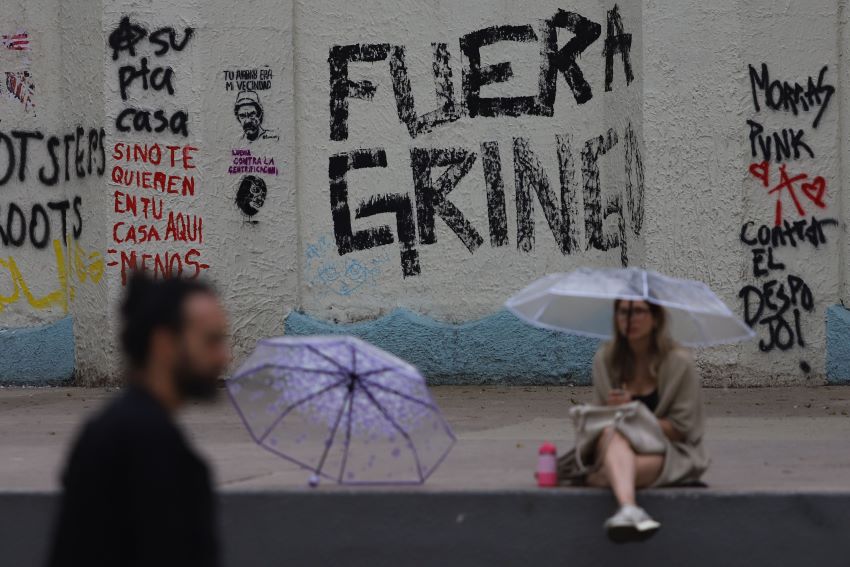
The protesters gathered on Friday afternoon in the Lindbergh Forum section of Condesa’s Parque México, where they held up placards with messages such as “Free us from American gentrification”; “You’re visiting paradise, we’re being pushed out”; “You’re not an expat, you’re an invader”; “Foreigners love Mexico, but hate Mexicans;” and “Dispossession comes disguised as Airbnb.”
“Housing to live in, not to invest in!” read a large banner affixed to the imposing five-pillared structure in Lindbergh Forum, a popular gathering and recreation place for both Mexicans and foreigners.
“We’re sick of foreigners coming with their euros and their dollars, wanting to buy our homeland,” said one rally speaker.
“… At the end of the day, if we begin to allow these kinds of things, there won’t be anything or anyone to stop them,” he said.
The protest was organized under the slogan “Gentrification is not progress, it’s dispossession.”
It was promoted on social media by various organizations, including one called Frente por el Arraigo y la Inclusión Vecinal (Front for Neighborhood Roots and Inclusion).
Most of the protesters were young people, among whom were residents, and former residents, of inner-city Mexico City neighborhoods such as Condesa, Roma and Juárez. However, the majority of the protesters live in other parts of the city, according to media reports.
“¡Gringos, go home!”: En la colonia Condesa se realizó la primera manifestación en contra del aumento de rentas y el desplazamiento de vecinos a causa de la gentrificación.
Durante la protesta quemaron una piñata que representa a los extranjeros gentrificadores.
Videos:… pic.twitter.com/utIn86tQFx
— Emeequis (@emeequis) July 5, 2025
The number of foreigners living in neighborhoods such as Condesa and Roma increased significantly during the COVID-19 pandemic. Many of the residents are from the United States, and include people who work remotely for companies in the U.S. and thus earn salaries in dollars.
The influx of foreign residents, and foreign tourists, has changed the face of neighborhoods such as Condesa and Roma and contributed to an increase in rents, forcing some Mexicans out and preventing others from moving into highly desirable parts of the capital. Inflation and other factors have also contributed to an overall higher cost of living in Mexico City and other parts of the country.
The resentment some Mexicans harbor toward well-off foreign residents of the capital is not solely based on rising prices and gentrification, but also stems from perceptions that some of the outsiders make little effort to assimilate and learn Spanish, and don’t significantly contribute to local tax collection.
“You walk around here in Condesa and every two steps you see a foreigner,” one protester told the news magazine Proceso.
“… [They are] people who don’t speak our language, don’t share our culture and are displacing [Mexicans],” he said.
Similar protests against gentrification and mass tourism have taken place in various cities around the world, including Barcelona and Paris.
‘Gringos go home!’
Chants of “¡fuera gringos!” (gringos out!) and “gringos, go home” rang out in Parque México during the demonstration and as protesters subsequently marched through nearby streets of the capital.
While foreigners from many countries around the world live in Condesa, Roma and other central neighborhoods of Mexico City, much of the protesters’ anger was focused on newcomers from the United States.
“Gringo, go back to your fucking country!” and “pinches gringos culeros” (fucking gringo assholes) were among the messages protesters conveyed on signs they held up.
Adding to protesters’ particular anger toward Americans is the unfair treatment many Mexicans believe their compatriots are receiving in the United States as the Trump administration pursues its mass deportation agenda.
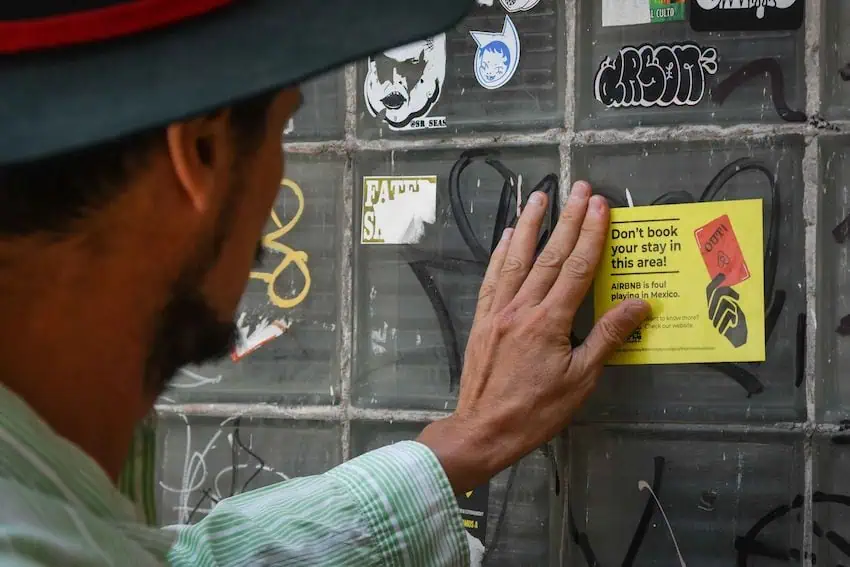
In Condesa, some protesters told media outlets that their neighbors have been forced out of parts of Mexico City that are popular with foreigners because many residential properties have been turned into businesses or short-term accommodation advertised online on platforms such as Airbnb.
“We’re being left without neighbors,” one protester told the newspaper Milenio. “A lot of places are now businesses. The rents are going up.”
“We don’t have neighbors anymore,” 82-year-old Condesa resident Raquel Nava told Proceso at the protest in Parque México.
“I’m here because I’m worried that the social fabric of the neighborhood has been lost,” she said.
“… [My] neighbors lived in rentals but with the arrival of Airbnb they couldn’t pay the costs and they were evicted,” Nava said.
She described gentrification as the eviction of residents with ties to the local area and the arrival of “people who don’t integrate into the community.”
“… It’s not that I’m against foreigners, the doors were opened to them and they’re here, but they don’t appreciate the cultural heritage of these neighborhoods,” Nava said.
Michelle Castro, a 19-year-old university student, told the Associated Press that Mexico City “is going through a transformation.”
“There are a lot of foreigners, namely Americans, coming to live here. Many say it’s xenophobia, but it’s not. It’s just that so many foreigners come here, rents are skyrocketing because of Airbnb. Rents are so high that some people can’t even pay anymore,” she said.
Mexicans forced out of desirable central neighborhoods of the capital often face longer, more expensive commutes due to their relocation to cheaper, more peripheral areas of Mexico City.
While businesses such as cafes have proliferated in trendy neighborhoods that are popular with foreigners, the number of traditional businesses such as tortilla and butcher’s shops have declined in recent years, according to official government data.
“A lot of the flavor of the neighborhood is lost,” Erick Ramírez, a long-time resident of Condesa, told Proceso.
“… Stationery stores, dry cleaners and corner stores disappear,” and “more profitable businesses” appear in their place, he said.
While some of the new businesses are owned by foreigners, the proprietors of many of them are Mexicans, who have no doubt benefited from the influx of Americans, Europeans and others with ample disposable income. Airbnb entrepreneurs have also reaped major monetary rewards from the arrival of large numbers of foreigners.
Karla Mejía, a Condesa resident, spoke about economic inequality between foreigners and Mexicans.
“We, as residents, as taxpayers of the Mexican state, can’t afford housing, much less in an area like Condesa, but these people can,” she told Milenio.
Condesa is a leafy, pretty neighborhood and entertainment hub that many people consider ground zero for gentrification in Mexico City. Its array of entertainment options, including cafes, restaurants and bars, its inviting parks and its central location are among the reasons why it attracts large numbers of foreign residents and tourists.
The protest turns violent
While most protestors demonstrated peacefully, a small group committed acts of vandalism and violence in Parque México and nearby streets.
The large structure in Lindbergh Forum was defaced with graffiti messages, including “Housing is a right, not a commodity” and “My culture is not your trend” as well as pro-Palestine statements.

Advertising by Adpathway







;)