


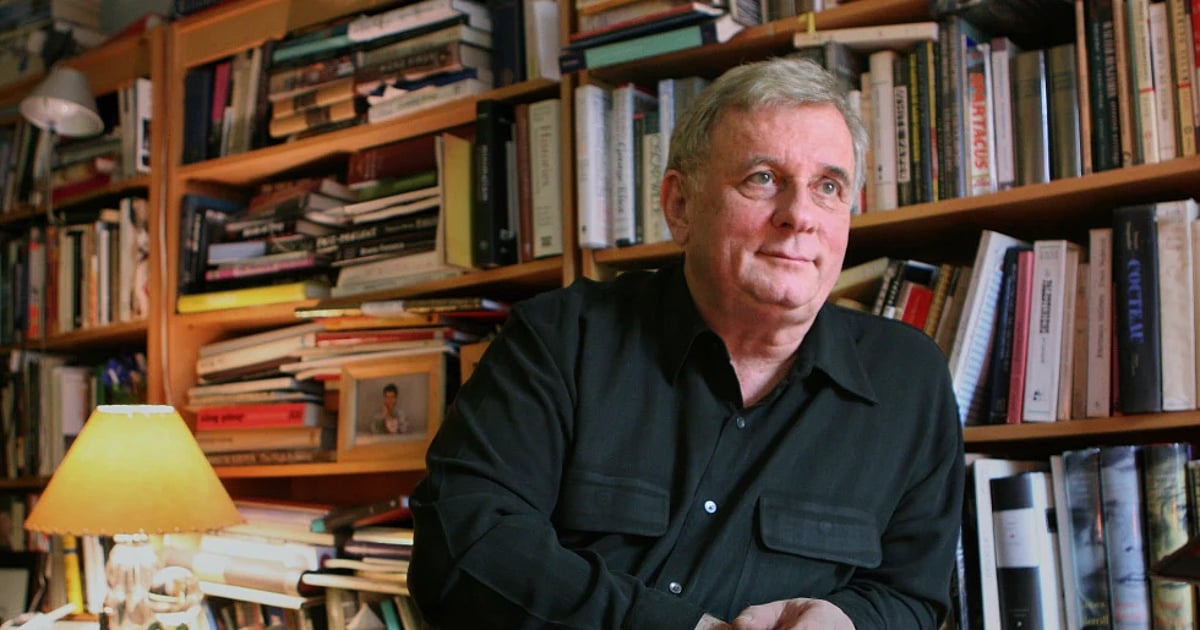
How groundbreaking gay author Edmund White paved the way for other writers
Greer and other authors speak of White’s work as more than just an influence, but as a rite of passage: “How a queer man might begin to question all of the deeply held, deeply religious, deeply American assumptions about desire, love, and sex — who is entitled to have it, how it must be had, what it looks like,” says Robert Jones Jr., whose novel above love between two enslaved men, “ The Prophets,” was a National Book Award finalist in 2021.
Jones remembers being a teenager in the 1980s when he read ”A Boy’s Own Story.” He found the book at a store in a gay neighborhood in Manhattan’s Greenwich Village, “the safest place for a person to be openly queer in New York City,” he said.
“It was a scary time for me because all the news stories about queer men revolved around AIDS and dying, and how the disease was the Christian god’s vengeance against the ‘sin of homosexuality,’” Jones added.
“It was the first time that I had come across any literature that confirmed that queer men have a childhood; that my own desires were not, in fact, some aberration, but were natural; and that any suffering and loneliness I was experiencing wasn’t divine retribution, but was the intention of a human-made bigotry that could be, if I had the courage and the community, confronted and perhaps defeated,” he said.
Starting in the 1970s, White published more than 25 books, including novels, memoirs, plays, biographies and “The Joy of Gay Sex,” a response to the 1970s bestseller “The Joy of Sex.” He held the rare stature for a living author of having a prize named for him, the Edmund White Award for Debut Fiction, as presented by the Publishing Triangle.
“White was very supportive of young writers, encouraging them to explore and expand new and individual visions,” said Carol Rosenfeld, chair of the Triangle. The award was “one way of honoring that support.”

Advertising by Adpathway