


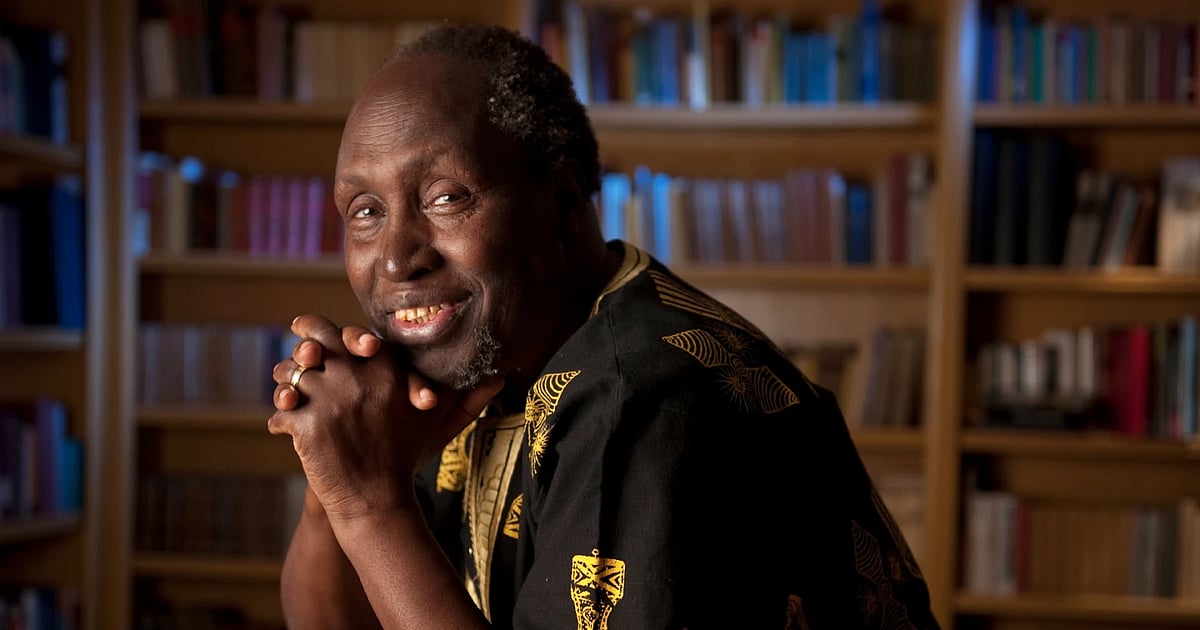
Ngũgĩ wa Thiong’o, Kenyan author and dissident who became a giant of modern literature, dies at 87
“He evoked for me, an unforgettable picture of a peasant revolt in a white-dominated world,” Ngũgĩ later wrote. “And suddenly I knew that a novel could be made to speak to me, could, with a compelling urgency, touch cords deep down in me. His world was not as strange to me as that of Fielding, Defoe, Smollett, Jane Austen, George Eliot, Dickens, D.H. Lawrence.”
By the late 1960s, he had embraced Marxism, dropped his Anglicized first name and broadened his fiction, starting with “A Grain of Wheat.” Over the following decade, he became increasingly estranged from the reign of Kenyan President Jomo Kenyatta. He had been teaching at Nairobi University since 1967, but resigned at one point in protest of government interference. Upon returning, in 1973, he advocated for a restructuring of the literary curriculum. “Why can’t African literature be at the centre so that we can view other cultures in relationship to it?” Ngũgĩ and colleagues Taban Lo Liyong and Awuor Anyumba wrote.
In 1977, a play he co-authored with Ngũgĩ wa Mirii, “I Will Marry When I Want,” was staged in Limuru, using local workers and peasants as actors. Like a novel he published the same year, “Petals of Blood,” the play attacked the greed and corruption of the Kenyan government. It led to his arrest and imprisonment for a year, before Amnesty International and others helped pressure authorities to release him.
“The act of imprisoning democrats, progressive intellectuals, and militant workers reveals many things,” he wrote in “Wrestling With the Devil,” a memoir published in 2018. “It is first an admission by the authorities that they know they have been seen. By signing the detention orders, they acknowledge that the people have seen through their official lies labeled as a new philosophy, their pretensions wrapped in three-piece suits and gold chains, their propaganda packaged as religious truth, their plastic smiles ordered from above.”
He didn’t only rebel against laws and customs. As a child, he had learned his ancestral tongue Gikuyu, only to have the British overseers of his primary school mock anyone speaking it, making them wear a sign around their necks that read “I am stupid” or “I am a donkey.” Starting with “Devil On the Cross,” written on toilet paper while he was in prison, he reclaimed the language of his past.

Advertising by Adpathway







;)