


By: Amber
What is spirituality? Are there actual signs or symptoms of spiritual awakening?
Of all the topics we cover here, spiritual awakening is perhaps the most misunderstood.
Let’s resolve that confusion now and ensure that we’re on the path to authentic spiritual awakening.
What is Spiritual Awakening?
Spiritual awakening is an awakening of a dimension of reality beyond the confines of the ego. The ego is our exclusive sense of self or “I.”
This awakening occurs when the ego somehow lets go so that a Higher Self or Spirit can arise within.
The average individual is more archetypal than human. That is, the ego is mostly a collection of archetypes, programs, or set behavioral patterns. The Taoists call this series of programs the acquired mind—a set of mundane conditioning we collect since birth.
Spiritual awakening implies the return of what the Taoists call the Original Spirit, or what Jung called the Self. It’s this return of Spirit that makes us truly human.
Spirituality versus Enlightenment
One of the reasons there’s so much misunderstanding around the topic of spiritual awakening is that we often fail to define relevant terms.
For example, in A Sociable God (2005), philosopher Ken Wilber provides nine valid definitions of spirit and spirituality.
We often link “spirituality” to the context of religion, but in my experience (as we’ll see below), this is problematic. For now, let’s define the spiritual as a quality of being beyond the physical or material domain of existence.
Enlightenment, too, can mean many different things, but it’s most often associated with cognition. You can have an “enlightened mind” through the disciplined study of higher spiritual principles. But this enlightenment doesn’t mean you’re spiritually awake or psychologically aware.
Spiritual Awakening versus Psychic Awakening
Another common confusion is between the terms spiritual awakening and psychic awakening.
Psychic awakening relates to the activation of the pineal gland. With it, you open up to other dimensions of reality beyond this limited three-dimensional realm of “space” and “time”.
Spiritual awakening, in contrast, involves opening the heart center. It’s a process more closely associated with one’s psychology, the emotional body, and the soul.
What is the Ego and the Spirit?
The ego believes it’s in charge. This ego is our sense of self or “I.” When you say things like:
- “I am [your name].”
- “I have a [job, house, car, mother, father, spouse, child, headache].”
- “I think [insert a thought].”
That’s the ego. It’s possessive because it experiences itself as separate from everything else.
This “lower soul” is largely driven by base pleasures, emotions, and trying to meet its basic human needs. The appetite of the lower soul is insatiable and, if left unchecked, it goes on for eons.
When Maslow said, “Man is a perpetually wanting animal,” he was referring to the ego.
Thankfully, there’s also a Spirit, Higher Self, or Higher Soul. And this divine spark isn’t driven by basic needs. Instead, this Spirit is calm, neutral, alert, compassionate, understanding, and intuitive.
While the ego accumulates knowledge through learning, the Spirit intuits reality by what it is. The ego thinks. The Spirit knows.
While the ego is always doing, the Spirit remains eternally in a state of being.
Here’s What Happens During Spiritual Awakening
We tend to identify exclusively with the ego as our sense of self.
As the process of spiritual awakening unfolds, the ego begins to sublimate to the Spirit. In the language of Taoism, the lower soul gets refined into the higher soul.
Arriving at this Spirit, or psychic wholeness, was the goal of Jung’s individuation process.
But despite popular belief, this doesn’t generally happen in a single “moment of awakening.” While we can have “peak experiences” that open us up to self-transcendent reality, these experiences tend to be fleeting.1Abraham Maslow, Religion, Values, and Peak-Experiences, 1964.
Instead, the developmental literature explains that there are stages of psycho-spiritual growth. And these permanent stages tend to develop over time.
This is part of the reason many people get confused about spiritual awakening. Walking in nature or while on a psychedelic substance, they may have a beautiful experience of oneness, for example, but this experience is momentary—fleeting. Some peak experiences can last weeks, even months.
However, the individual’s structure of consciousness hasn’t changed yet.
Spiritual Traps: False Signs of Spiritual Awakening
So before we go into authentic symptoms of spiritual awakening, let’s review common false signs.
Trap #1: Thinking You’re “Good” and Others Are “Evil”
This belief is deeply rooted in most of us as it’s a typical program taught in all Western religions.
After false “awakenings,” there may be an inflated feeling of being “better than” (superiority). This is sometimes referred to as “false light.”
To uproot this belief requires shadow work. You’ll know you’ve undone this limiting belief when you stop judging others and instead see yourself in everyone you meet.
Trap #2: Identifying Yourself as a “Spiritual Person”
This false identification is universal in both religious and new-age circles. You are either spiritual AND material—or neither of them. You can transcend and include them both.
Identifying yourself as being spiritual is a sign of a spiritual ego or inflation (discussed below). It’s a sign that you’re what Jung called “one-sided.”
Again, shadow work will help you see that you’re no different or better than anyone else.
Trap #3: Seeking “Love and Light”
Pursuing “love and light” or “goodness” is another deep-rooted program in religious and new-age teachings that block authentic spiritual development.
Acting “spiritual” creates a persona or social mask that gives others the impression that we’re “good people.” While this persona might elevate our status and increase our self-esteem, it does not promote psychological or spiritual growth.
In truth, spiritual awakening comes from the opposite direction where we face the fear, anger, guilt, and grief stored in us since childhood. Coming to terms with these experiences paves the way for authentic spiritual development.
Trap #4: Acting Nice
Acting nice and being innocent isn’t a spiritual awakening sign but an indication of psychological immaturity.
We are told by our parents and various institutions (school, religion, etc.) to “be nice” and behave ourselves. In complying with this demand, we reinforce the shadow.
If you’re acting nice, it’s a sure sign that someone is manipulating you. (The original manipulator or Trickster is usually a parent, but now it’s in you.) In contrast, a mature adult acts assertively without seeking the approval of others.
Trap #5: Secretly Believing You’re Better Than Others
Perhaps you see a pattern here: all of these traps point to ego inflation.
Spiritual awakening grounds us in our humanity, and yet, more often, spirituality becomes another tool for disassociation, judgmentalism, and grandiosity.
This trap often occurs when you:
- Read a lot of spiritual texts
- Join a spiritual or religious group
- Start a spiritual practice
- Find a spiritual teacher
Specialness is yet another ego game.
When you think you’ve “found it,” be on high alert. This belief is a symptom of a specific early stage of psychological development, not a spiritual awakening sign.
All of these subconscious signs also point to energy vampirism.
Beware of the Spiritual Bypass
Perhaps the biggest trap in the spirituality game is called the “spiritual bypass.”
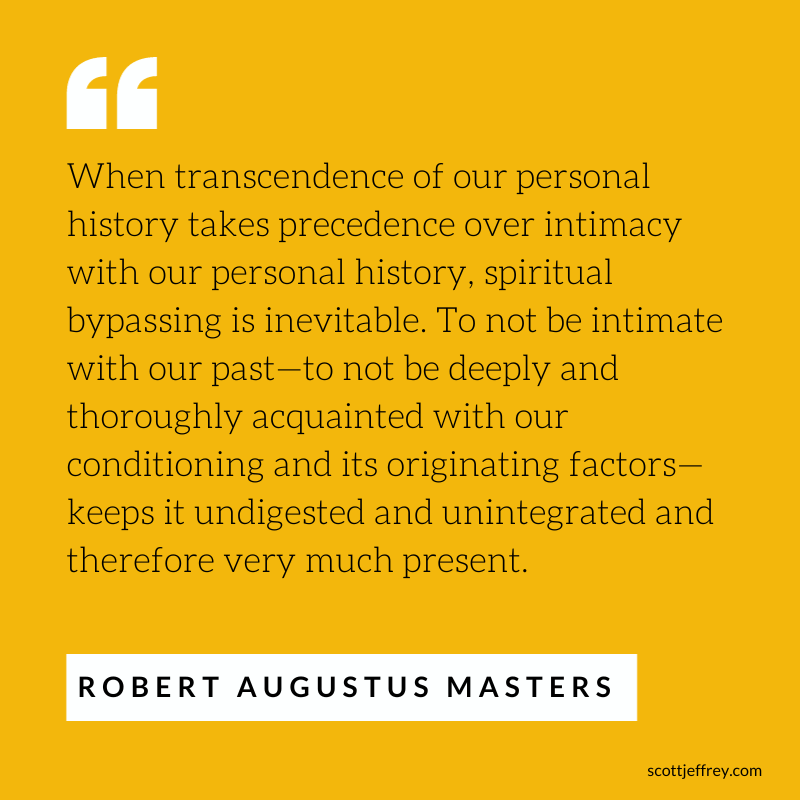
Here, we use spiritual ideas and practices to avoid unresolved emotional or psychological wounds. These wounds must be addressed to proceed in our psycho-spiritual development.
We often resist this process because addressing these wounds requires going through the discomfort they represent.
These wounds are mainly related to childhood trauma. Virtually every emotional trigger you have in your present environment is likely from your past.
As Heidegger puts it, “The Dreadful has already happened.”
A great many individuals in various Eastern and Western religions fall into the spiritual bypass trap. I did too for most of my 30s.
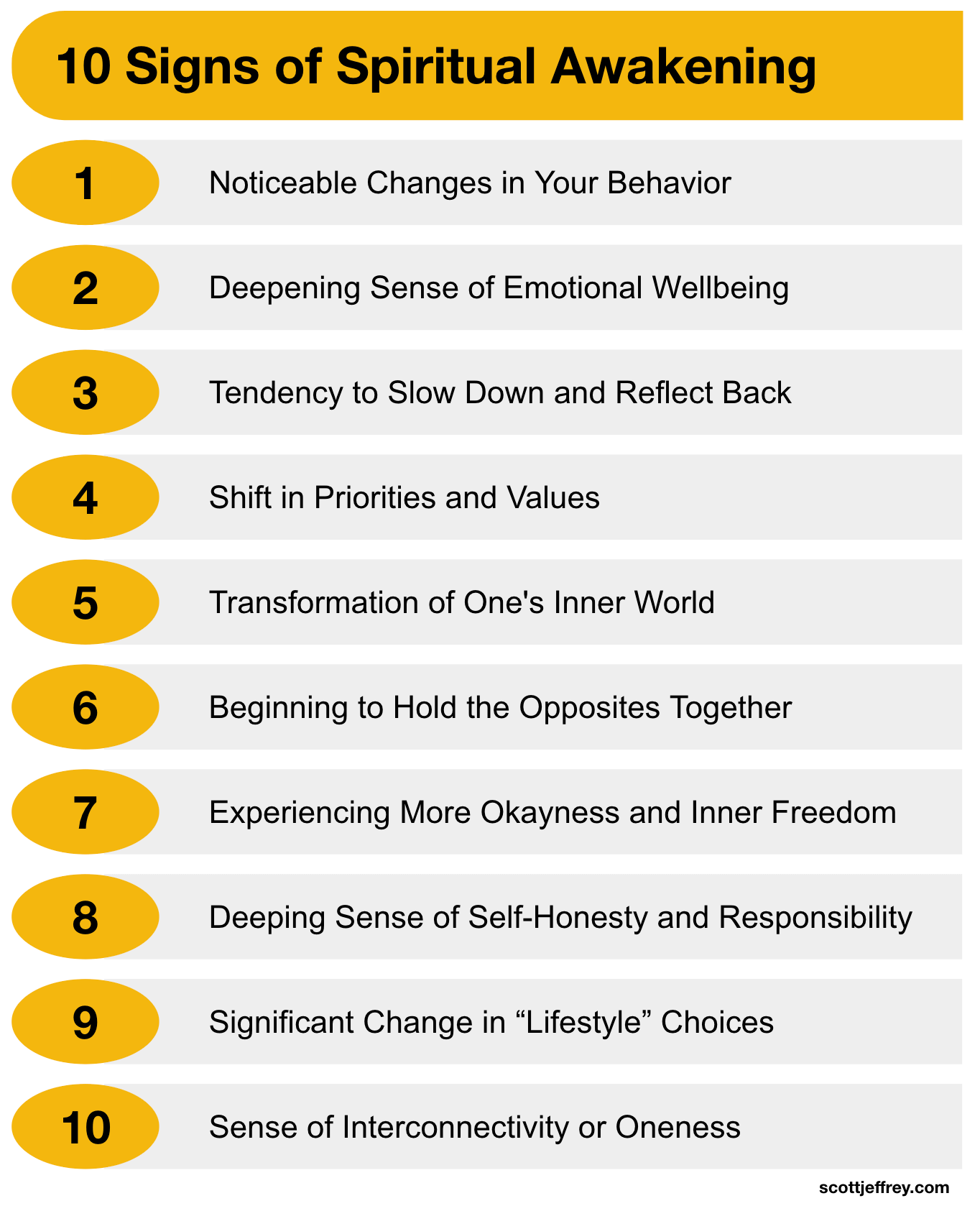
10 Signs of Spiritual Awakening
While there isn’t a codified “spiritual awakening process,” there are signs and symptoms along one’s spiritual journey.
Now that we’ve looked at some of the false signs of spiritual awakening, let’s review some of the authentic indications.
Sign #1: A Noticeable Change in Your Behavior
Perhaps the most essential and authentic signs of spiritual awakening can be observed in your daily behavior.
Compulsive, neurotic, and addictive behaviors are symptoms of the ego or lower soul. The Spirit or Higher Self has no such tendencies.
The Spirit isn’t driven to meet basic needs because it’s already whole and complete right now. So when you feel this completeness or okayness, moment to moment, it’s a good sign of spiritual awakening.
As a consequence of this okayness, you may be genuinely kinder (and less reactive) toward others without trying to be.
Sign #2: A Deepening in Your Emotional Wellbeing
Disruption in our emotional body is perhaps the main thing that blocks spiritual awakening. Jung called it a wounded feeling function. In resolving emotional trauma from childhood, we undo this wound, enabling us to feel more deeply and genuinely.
Re-engaging this emotional flow influences every area of our lives. Now, instead of being possessed by a host of archetypes, we become more authentically human.
As such, there’s less resistance to feel (even negative emotions we resisted before). Instead of sedating yourself and running from your feelings, there’s a growing willingness to confront emotions like fear, anger, and guilt.
At the same time, as the mind becomes more steady, there are fewer emotional triggers. Neutrality becomes a desirable way of being.
Sign #3: A Tendency to Slow Down and Reflect Back
For the above signs of spiritual awakening to unfold, self-reflection is necessary when you turn back to understand the present.
This “reflecting back” is challenging in modern times due to the fast pace we tend to run. The drive for achievement, productivity, and peak performance have their place, but they can quickly become signs of neurosis. For spiritual awakening, laziness can become our friend.
So another spiritual awakening symptom is that you begin to slow down more often and reflect back. An impulse comes alive in you to more clearly understand yourself and your behavior. The Chan Buddhists call this Stopping and Seeing.2Chih-i, Trans. Thomas Cleary, Stopping and Seeing: A Comprehensive Course in Buddhist Meditation, 1997.
Reflecting helps us access repressed memories in our unconscious that cause irrational behavior in the present. But this self-reflective drive doesn’t judge, blame, or criticize, as the Spirit is neutral yet curious.

Sign #4: A Shift in Priorities and Values
Locating authority within ourselves changes our values. Religion provides a moral code based on a system of rules. “Do this; don’t do that.” But now we can develop our own ethical framework where we evaluate what’s best in the context of the situation. The ego is unable to do this because basic needs drive it; only the Higher Self can.
This shift toward higher virtues is why our behavior changes during spiritual awakening. Maslow called these spiritual values “being values” or B-values, and they include wholeness, perfection, completion, justice, aliveness, beauty, truth, and self-sufficiency.
Sign #5: A Transformation of One’s Inner World
In the average person’s waking state, an individual’s ego is almost exclusively focused on their outer world. Work, money, achievement, image, family, friends, and social life are all elements of the external environment.
Another sign of spiritual awakening is a profound shift from this external world to one’s inner realm of thoughts, feelings, dreams, and imagination. In Buddhism, this dimension is called the subtle realm, and it’s considered more real than the “gross dimension” of our waking state.
Sign #6: Holding the Opposites Together
Most of us have a rather rigid, fundamentalist mind that sees things in black and white. Red and Blue, Democrat and Republican, Good and Bad … you get the idea.
To avoid the ambiguity inherent in mature adulthood, we cut off one pair of opposites and identify exclusively with the other. For example, as parents, we might think we unconditionally love our children without acknowledging the wellspring of resentment we have toward them.
While dissociating from one pair of the opposite seems to resolve our ego’s tension, in truth, it only re-enforces our shadow. With spiritual awakening, we begin to hold the tension of opposites within us, putting us on the road to psychic wholeness.
Sign #7: An Experience of Okayness and Inner Freedom
The ego is our source of fears, desires, and constant tension. When the ego bows to the Spirit, there’s an inherent sense of okayness—regardless of what’s happening in our lives (good or bad).
When the Spirit is at the helm, we naturally relax into ourselves, providing a sense of inner freedom we once sought in the external world. In Hinduism, they call this moksha or self-liberation.
Sign #8: A Deeping Sense of Self-Honesty and Personal Responsibility
As you begin to locate more authority within, there’s a willingness to be radically honest with yourself. You simply can’t tolerate the inner trickster’s game of self-deception anymore.
Now, you feel a growing sense of responsibility and accountability for your thoughts, emotions, and actions. It’s for this reason that psychotherapist David Richo says the last gateway to mature adulthood is guilt.3David Richo, How to Be an Adult: A Handbook for Psychological and Spiritual Integration, 1991.
When we’re unconscious of our behavior, there’s no accountability. When there’s no accountability, there’s nothing to feel guilty about. But the guilt that comes from spiritual awakening isn’t from someone else shaming you; it’s from your conscience, driven by a desire to correct your way of being.
Sign #9: A Massive Change in Lifestyle Choices
Another noticeable sign of spiritual awakening is that you become highly conscious of your lifestyle choices. Many “normal” things we did before become unacceptable now.
As your connection to the Earth increases, for example, your concern for your environmental impact begins to alter your behavior. (See the updated section below on eating animals as an illustration.) Ethics becomes a larger driving force over convenience.
Sign #10: A Sense of Interconnectivity or Oneness
The ego, or as philosopher Alan Watts calls it, the superficial self, feels separate and alone. It fears for its safety, clinging to life while fearing death.
The Original Spirit has no such fear or sense of separation. It doesn’t play the ego’s game of “us versus them.” The Spirit doesn’t identify itself with gender, race, nationality, religion, or a species. It simply is. It exists outside of space and time, so death isn’t a relevant concept for it either.
I’ll leave it to Alan Watts to drive this point home:
The Role of Religion in Spiritual Awakening
In reading the works of thinkers like Carl Jung, Joseph Campbell, and Ken Wilber, you begin seeing a clear distinction between:
- Being religious and
- Being spiritual.
While I won’t say that you can’t be both religious and spiritual, I will say that they are VERY different ideas. Perhaps in its purest form, religion could help individuals develop spiritually. However, observing around the world, the opposite is more often the case.
That is, religion (both East and West) more often inhibits one’s natural spiritual progression as it tends to keep us fixated on a low level of psychological development. As such, many individuals must transcend their religious upbringing (programming) to experience the above-listed signs of spiritual awakening.
Meditation and Spiritual Awakening
While those pursuing spiritual awakening often meditate, meditation is a means, not an end. What do I mean?
Meditation is a mechanism to calm, quiet, and stabilize the mind, but by itself, it doesn’t necessarily foster spirituality or psychological development. (In fact, meditation can easily promote inflation for the spiritual ego that feels superior because it meditates while others do not.)
Meditation is important. Learning how to calm and quiet the mind allows us to reflect—one of the signs of spiritual awakening.
See: The Best Meditation Posture for Beginners, Intermediates, and Advanced Practitioners
Does Eating Meat Relate to Spiritual Awakening?
When I published the original version of this guide in 2018, I knew addressing the topic of eating meat was going to be controversial. As expected, this particular sign was polarizing for many readers and triggered reactions in the comment section below.
With awakening to your spirituality, oftentimes there’s a complete aversion to eating meat or any animal products.
Now, I realize this statement can trigger many readers, so allow me to explain. This is not about vegetarianism, veganism, animal rights, or any other ideology of any kind.
This is about Energetic Sensitivity and Heightened Awareness (not ideology)
This spontaneous aversion to eating animals occurs from a combination of a deeper connection to one’s body and an expansion of one’s internal awareness.
As a meat eater for most of my life, I would have revolted against this notion.
But like millions of others, after following certain practices for many years, this realization became apparent: when you eat an animal you are consuming and assimilating the consciousness of the animal. That is, you begin to feel, at a visceral level, the emotions and life of the animal.
Usually, the feeling is aggression or fear—the last emotion the animal felt before being slaughtered. When this experience occurs, there’s a good chance that you will stop eating meat.
One qigong teacher explained to me that eating meat causes us to be more aggressive. In chi energy cultivating, this added aggression doesn’t serve us. (Not every qigong practitioner would agree with this.)
So again, this lifestyle change is not a function of adopting any ideology or opinions; it’s an internal experience that comes from an expansion in one’s consciousness.
What happened when millions of people tripped on acid?
Millions of people stopped eating meat in the late 1960s. Why? They were tripping on LSD and other psychedelic substances available at the time and expanding their consciousness.
All of a sudden, many individuals became vegetarians and had a strong drive to live in harmony with the land. Then, the government classified LSD as a Class 1 substance, making it illegal. See Terrance McKenna’s Food for the Gods and Martin Lee’s Acid Dreams for a complete breakdown.
Many individuals in the plant medicine community also report losing their desire to eat meat when they are on the substance.
Also, it’s been documented that the ancient Taoist practitioners only consumed meat when someone became ill (in the form of chicken or fish soup). See Healing with Whole Foods by Paul Pitchford.

Does this mean you can’t eat meat and be spiritual?
Of course not. There are many levels of progression in any line of development, including spirituality.
And just because you don’t eat meat doesn’t make you spiritual either. You can be a vegan and still be a horrible person.
We’ve been culturally conditioned to eat meat for millennia. So this pattern isn’t likely to change overnight.
How can you test this out for yourself?
If you’ve developed energetic sensitivity in your body and you avoid eating meat for about 90 days and then eat it again, you’ll likely be amazed at your experience.
NOTE: Without performing this experiment with a beginner’s mind, despite any discomfort that might arise, the individual is not in a position to evaluate what’s being stated here.
Instead, confirmation bias will cause the individual to close off to what’s described above. Our consciousness is very powerful in that way.
Well, aren’t plants alive too?
The question that often comes next is: Well, aren’t plants also alive? Aren’t you consuming their consciousness by eating them too?
The answer to both of these questions is yes. This poses the next level of internal tension one must resolve along one’s path of spiritual awakening.
But eating plants isn’t the same as eating animals. Plants don’t have blood, a heart, organs, and a brain like animals do.
With this level of spiritual awakening can come the understanding that eating meat is a form of cannibalism, an act we most likely wouldn’t have chosen if we were given the choice when we were a child. (Many children demonstrate a strong aversion to eating meat when they are first presented with it.)
I’ve been informed by two different occult researchers whom I respect that meat-eating is a black-magic ritual—down to how the animals are killed and the positioning of slaughterhouses.
But isn’t animal protein essential for our survival?
And in case you believe you need meat protein to thrive, watch this interview with a vegan strongman who only eats one meal a day.
Or, as Nikola Tesla wrote,
“Many races living almost exclusively on vegetables are of superior physique and strength. There is no doubt that some plant food, such as oatmeal, is more economical than meat, and superior to it in regard to both mechanical and mental performance.”
Changing your lifestyle in this way should happen spontaneously instead of by an act of will. Also, keep in mind that this is just one sign of spiritual awakening; it’s not the only sign.

How to Approach Spiritual Awakening
From my experience, a practical approach to spiritual awakening works on multiple levels: physical, emotional, mental, and energetic.
The stabilization of one’s mind helps you cultivate a reflective mind. A reflective mind supports shadow work, which from my perspective (and transpersonal research), is one of the most essential practices for those of us on a spiritual path interested in realizing mature adulthood.
The barriers to spiritual awakening are very simple: fear, anger, guilt, and grief. Cultivating self-leadership is a natural path toward authentic spirituality. (See How To Be An Adult by David Richo for more instruction.)
Spiritual awakening comes down to cultivating self-awareness and building consciousness. With this increasing awareness, we can shift beyond self-actualization and into the realm of self-transcendence.
Your identity begins shifting away from your ego because there are fewer internal tensions and self-identification. This process happens naturally without “trying” to make it happen.
By learning to abide in one’s Center, without succumbing to inflation or deflation, we can support the process of our natural spiritual development. To access this Center instinctively, it’s most helpful to reforge your connection to your body.
Recap: Signs of Spiritual Awakening
The false spiritual awakening signs all have to do with ego inflation. They are symptoms of grandiosity and self-delusion.
Authentic signs of spiritual awakening are similar to characteristics of mature psychological development and what we can call humanness.
Here are valid signs of spiritual awakening:
- One locates authority within oneself. (See this guide on psychological projection.)
- A growing sense of responsibility for one’s thoughts, attitudes, feelings, and behavior.
- Cardinal virtues begin to supersede (but not replace) the values of this material world.
- Things slow down, allowing you to reflect and understand your past.
- As a consequence, your mind is calmer and you have fewer emotional triggers.
- You begin to focus more on your inner experience than your outer environment (but the outer is still important too).
- When the Self is at the wheel, there’s a feeling of okayness and inner freedom. You feel light and free.
As they explain in the wisdom traditions, the primary key to accelerating spiritual awakening is to hold to your Center, again and again.
From the ancient Chinese philosopher Zhuangzi:
Flow with whatever may happen, and let your mind be free: Stay centered by accepting whatever you are doing. This is the ultimate.
Read Next
Duality and Nonduality Explained: Key Insights from the Nondualists
Feminine Energy and Masculine Energy Explained: Integrating the Opposites
The Best EMF Protection for the Home: A Practical Step-by-Step Guide
What Do You Think?
We covered a lot of ground in a short distance in this guide.
Share your thoughts and comments below.

Advertising by Adpathway







;)