



Vision: protecting and restoring a prized sense
Credit: Sam Falconer for Nature
Humans are endowed with a powerful suite of senses. Most people experience the world through sound, smell, touch, taste, temperature and pain, but it is vision that is valued the highest. A 2016 survey of adults in the United Kingdom found that, on average, people would rather live for 4.6 years with perfect health than for 10 years without sight (J. Enoch et al. JAMA Ophthalmol. 137, 1317–1320; 2019). Just think about that for a moment: these mostly healthy, wealthy adults were willing to trade more than five years of life for their sight. It’s a statistic that captures the importance of vision, but also the fear that often accompanies the idea of losing it.
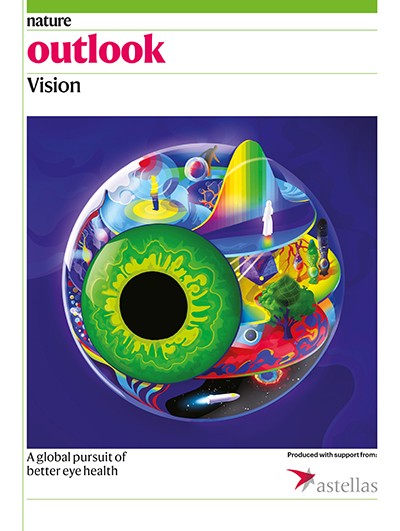
Nature Outlook: Vision
With such strong feelings on display, the scale of work being done to prevent and treat sight loss should be no surprise. Therapies for age-related macular degeneration (AMD), the most common cause of blindness in people over 50, are developing apace. For the advanced form known as geographic atrophy, the arrival of progression-slowing drugs in 2023 was a watershed moment. Improved options could well follow, including cell therapies. AMD treatment typically requires frequent injections directly into the eyeball — an uncomfortable status quo that gene therapy might upend.
For people who have already lost their sight, neuroscientist Lore Thaler at Durham University, UK, thinks that echolocation should be widely taught to help improve their quality of life. And for those with the genetic disorder retinitis pigmentosa, clinical trials of optogenetic techniques to restore vision are, sometimes, exceeding even their developers’ expectations. There is also progress in the prevention of vision disorders. Early diagnosis of eye conditions, powered by artificial intelligence, might be finally coming of age as the technology is rolled out in earnest in India and Thailand. And circling far above our heads, efforts are being made to address one of NASA’s ‘red risks’ for long-term space flight and prevent astronauts aboard the International Space Station from losing their sight. Whether at home or in space, eye health is clearly a priority.
We are pleased to acknowledge the financial support of Astellas Pharma in producing this Outlook. As always, Nature retains sole responsibility for all editorial content.

Advertising by Adpathway







;)