


How some viruses give you the sniffles year after year
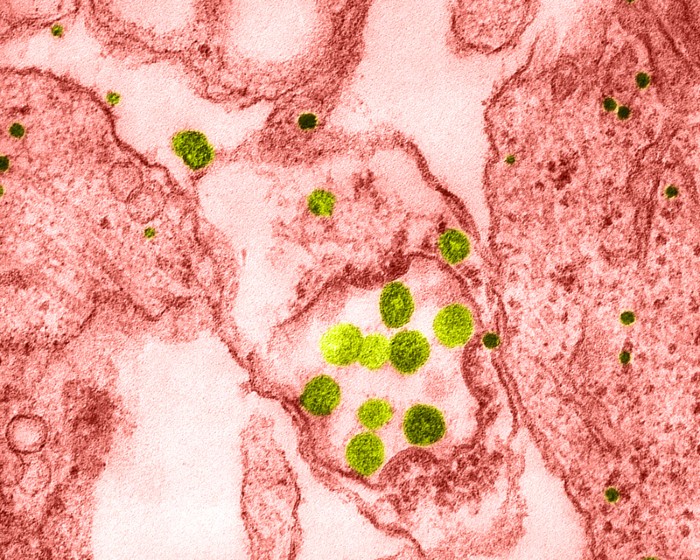
Particles (green, artificially coloured) of the cold-causing coronavirus HCoV-229E, whose genome shows evidence of swift evolution of a key protein. Credit: Science Source/Science Photo Library
Virology
How some viruses give you the sniffles year after year
At least two coronaviruses that cause the common cold can evolve to escape recognition by the body’s immune system.
Unlike their cousin SARS-CoV-2, human seasonal coronaviruses usually cause only mild respiratory symptoms. However, people can be repeatedly infected by them. To understand why, Kathryn Kistler at the University of Washington and Trevor Bedford at the Fred Hutchinson Cancer Research Center, both in Seattle, analysed genomic sequences from four seasonal coronaviruses that have been known for years.
Some of the sequences examined code for a protein called spike, which the viruses use to infect cells. The researchers found that in at least two of the seasonal coronaviruses, a spike component called S1, which is a target of the human immune system, evolves at a relatively high rate. Changes beneficial to the virus appear in these proteins roughly every two to three years, and could help the virus to elude the body’s immune response.
These adaptations could explain why many people can be reinfected with seasonal coronaviruses, and might mean that any vaccines produced against these viruses would need to be continuously updated.
It is not clear whether SARS-CoV-2 will evolve in a similar way.

Advertising by Adpathway







;)