


A material cracks barriers to asymmetrical toughness
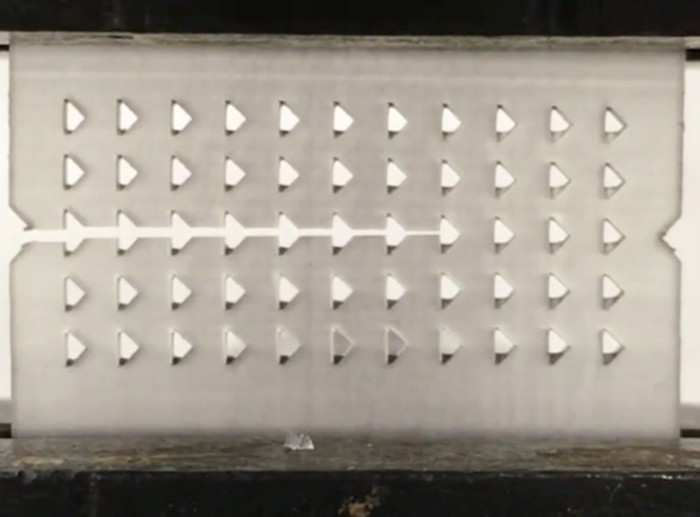
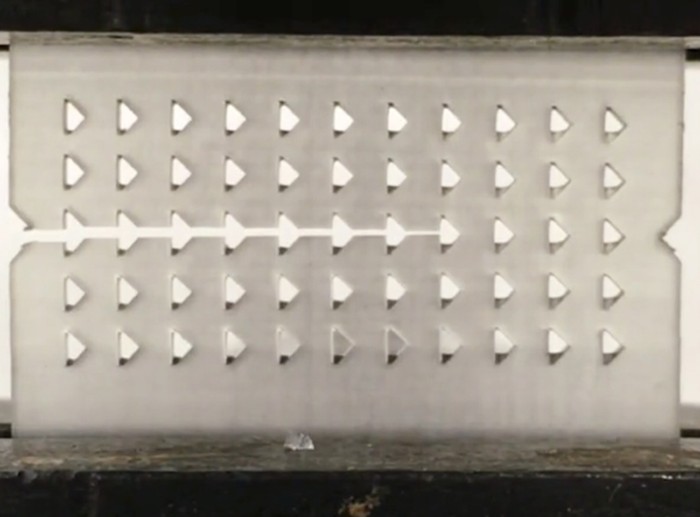
The triangular holes in this material make it more likely to crack from left to right than vice versa. Credit: N. R. Brodnik et al./Phys. Rev. Lett.
Materials science
A material cracks barriers to asymmetrical toughness
Researchers have demonstrated a material that is more resistant to cracks that propagate in one direction than in the opposite direction.
Katherine Faber and Kaushik Bhattacharya at the California Institute of Technology in Pasadena and their colleagues 3D-printed rectangular plates containing a regular array of triangular holes. The holes generally made the material tougher than it would have been without them. That’s because it is easier for an existing fracture to propagate than for a new fracture to form; each time a fracture reached a hole, the cracking had to start anew.
But when pulled from its edges, the material tended to break in a specific pattern: if the triangles pointed towards the right, a crack first formed on the left and propagated rightwards, because each triangle’s vertex focused the stress into one point and eased a new crack’s formation. This cracking sequence revealed that the patterning caused an asymmetrical improvement in toughness.
The authors say that their technique could help to steer cracks in a prescribed direction. In situations in which a failure is inevitable, this could help to protect critical components, they write.

Advertising by Adpathway







;)