

Trump's past speeches to Congress asked them to pass his agenda. Now, he's willing to go it alone
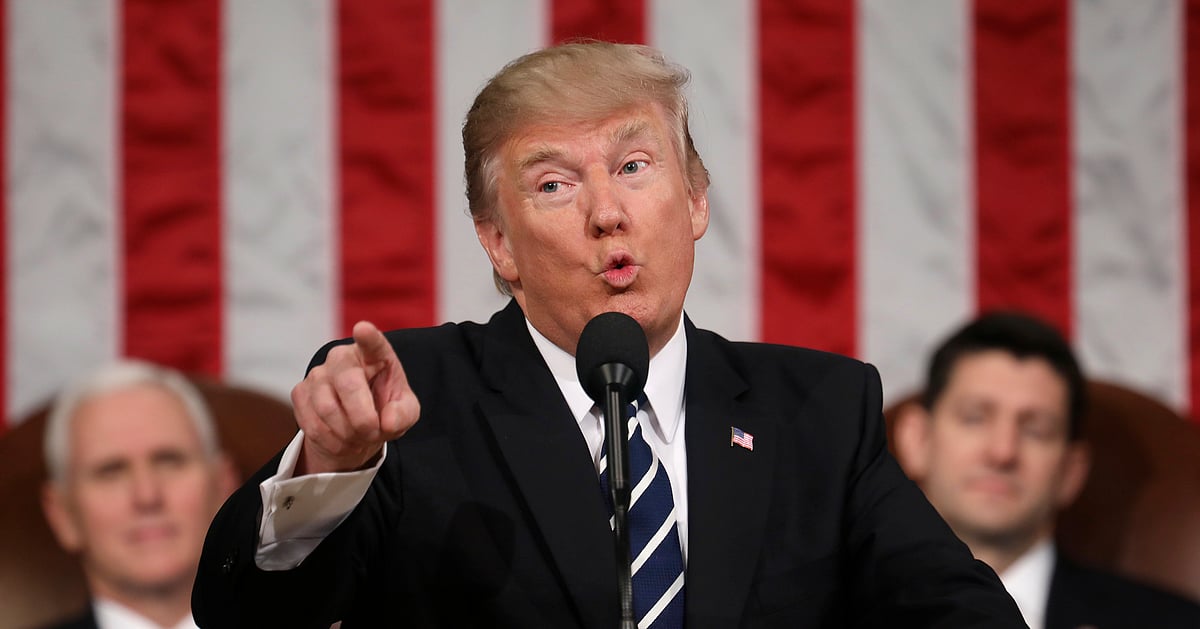
WASHINGTON: Judging by his past speeches to Congress, President Donald Trump once felt the need to ask lawmakers to pass his agenda. Not so much anymore.
Trump, who is addressing Congress on Tuesday night, has asserted his authority to reshape the federal government without needing to consult the legislative branch. That’s a break from his previous remarks to Congress in which he specifically sought lawmakers' backing on many of the actions he's now taking unilaterally.
On his own, Trump has signed order to levy punishing taxes on imports, deport immigrants in the country illegally, fire hundreds of thousands of federal workers and freeze congressionally approved spending. There are limits to that approach as he will still need lawmakers' help to extend his 2017 tax cuts.
But the speeches delivered during Trump’s first term show his evolution as a leader. His hopeful rhetoric in 2017 gave way to a 2020 State of the Union address in which Democrats were socialists. The event that defined the United States that year — the coronavirus pandemic — received only a brief mention by Trump.
‘The torch of truth, liberty and justice’
Going into his 2017 speech, Trump had already shocked the public with his decidedly bleak “American carnage” inaugural address. But for his address to Congress, Trump was more optimistic.
He started with a celebration of civil rights as February is Black History Month, an event the president at the time saw as creating a moral obligation for the country.
“Each American generation passes the torch of truth, liberty and justice in an unbroken chain,” Trump said. “That torch is now in our hands. And we will use it to light up the world. I am here tonight to deliver a message of unity and strength, and it is a message deeply delivered from my heart.”
This year, Trump goes into his speech after launching a wholesale effort to eliminate any diversity, equity and inclusion initiatives in the government, corporations and schools.
In his 2017 address, Trump laid out a seemingly bold set of promises to stop crime, secure the southern border, cut taxes and restore manufacturing as the engine of the U.S. economy. It was still a moment when the president himself was trying to navigate a Washington in which he was an outsider and stranger.
In his remarks, he suggested that tariffs would help iconic American companies such as Harley-Davidson, the motorcycle manufacturer. It was both an expression of his core belief in tariffs and a sign to critics that import taxes might not be the cure-all that Trump claimed.
When Trump spoke in 2017, stock in Harley-Davidson sold for more than $55 a share. The price fell jaggedly after his remarks and bottomed out during the 2020 pandemic. Since the start of 2025 with Trump’s return, the motorcycle maker’s share price has fallen further to $26.
‘Our new American moment’
In his 2018 State of the Union, Trump was coming off a big legislative victory with his Tax Cuts and Jobs Act.
Signed in December 2017, it permanently lowered the corporate tax rate to 21% and included a series of individual income tax cuts set to expire after 2025. Republicans stressed the breadth of the $2 trillion in tax cuts, while Democrats noted how they were tilted toward the wealthy.
“This is our new American moment,” Trump promised. “There has never been a better time to start living the American Dream.”
The president noted that employers had paid roughly 3 million workers “tax cut bonuses” and that median family incomes would increase by $4,000 ( which they more than did in 2019, only to fall with the pandemic and the spike in inflation during President Joe Biden's first two years in office).
Trump also noted that “Apple has just announced it plans to invest a total of $350 billion in America, and hire another 20,000 workers.” If that claim sounds familiar, it’s because over the past few days, the White House has highlighted Apple’s plans to invest $500 billion over the next four years, even though the company had already planned to increase its domestic manufacturing.
Trump also asked Congress to give the executive branch the power “to remove federal employees who undermine the public trust or fail the American people.” The president sought more than $1 trillion in infrastructure investments (which Biden ultimately provided with a bipartisan law ) as well as an immigration bill that would lock down the border but give “a path to citizenship for 1.8 million illegal immigrants who were brought here by their parents at a young age.”

Advertising by Adpathway







;)