


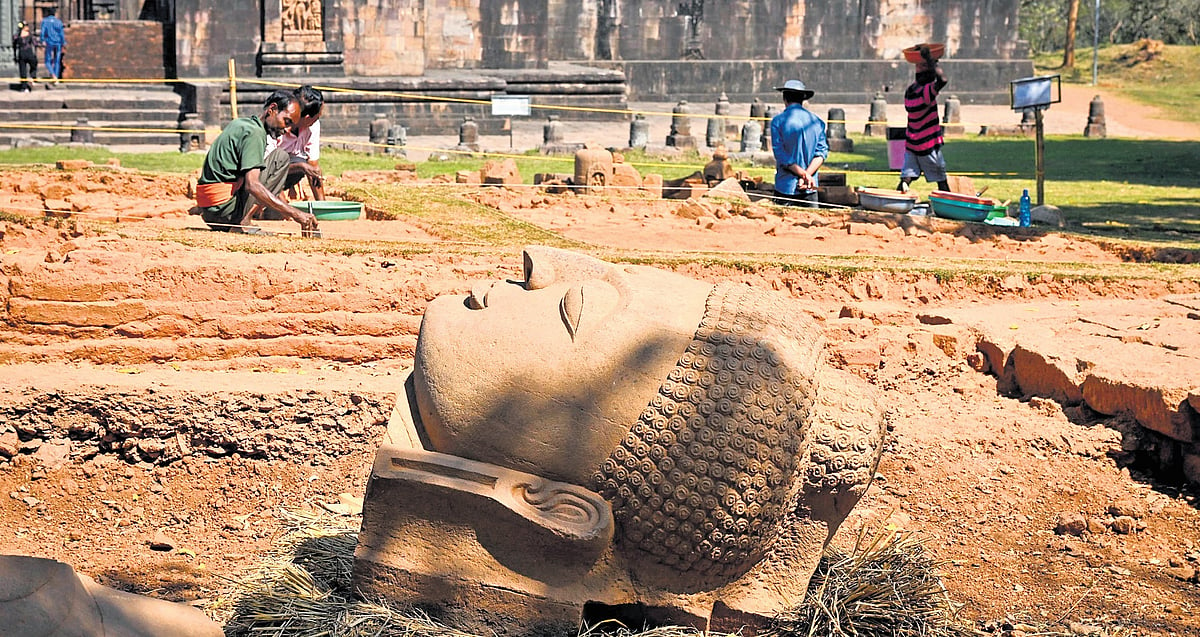
Odisha’s buddhist past makes itself present
Maritime Link & Tantrayana
It is believed that Buddhist establishments were generally patronised by traders from southeast Asian countries in the ancient times. The excavation is also directed towards finding Ratnagiri’s link with any Southeast Asian countries and archaeologists have been looking for related material culture at the site. However, they have had no luck so far except finding only a few celadon shards. Celadon ceramic pottery style has its origin in China. “Only if we get a lot of celadons, we can say that the site had a maritime link like Barabati and Khalkatapatna but that isn’t the case so far,” Garnayak said.
But what are being found in large numbers from the excavated shrine complex are idols of Buddhist gods and goddesses and votive stupas related to Vajrayana Buddhism. So far, archaeologists have dug out close to 50 idols of Buddhist deities like Tara, Chunda, Hariti, Avalokitesvara, Heruk, Marichi, Jambhala, Manjushri, Arapachana, Vajrasattva and Vasudhara, among others.
Also, hundreds of stupas, both monolithic votive stupas and structural stupas continue to be excavated from the mound. In the votive stupas, there are niches (small spaces carved into the structure) which house idols of Buddha in Bhumisparsa and Dhyana mudras and other deities like Aparchana, Avalokitesvara, Chunda and Dhyana. Votive stupas are generally offered by students or people in fulfillment of a vow. Bigger stupas have also been found which house four divinities in four directions. Stating that Ratnagiri has the highest number of votive stupas compared to any other Buddhist site in Odisha, Garnayak said it is the best site to study the iconographical feature of Vajrayana Buddhism.
ASI plans to continue Ratnagiri excavation for a few more months to trace out more monastic evidence, the presence of which is evident from the 18 acre site.

Advertising by Adpathway







;)